
A public-health plan can change for a good reason and still leave a weak record. Imagine a team at a community-centre entrance: one person moves a queue barrier while another updates the route on a floor-plan board. The visible change is easy to photograph. The harder and more useful task is to record what the team observed, why it interpreted that signal as a problem, what it changed, and what would make it review the decision again.
The World Health Organization's guidance on preparing and adapting tools for implementation stresses that adaptations should be assessed and documented rather than treated as invisible local improvisations. A short decision record puts that principle into daily practice without turning a small adjustment into a long evaluation report.
Separate the signal from the explanation
Start with the observation that another person could verify. At the entrance, perhaps several visitors walk past the first turn, staff repeatedly redirect them, or the barrier narrows the route for someone using a mobility aid. Write the time, place, group and repeated behaviour. Do not begin with âthe layout failedâ or âpeople were confused.â Those are interpretations, not observations.
Then add the team's best current explanation. The sign may be too far from the decision point. The barrier may guide attention toward the wrong doorway. A familiar staff member may be doing more of the work than the layout itself. More than one explanation can remain open. The record should make uncertainty visible rather than dressing a quick judgement as proof.
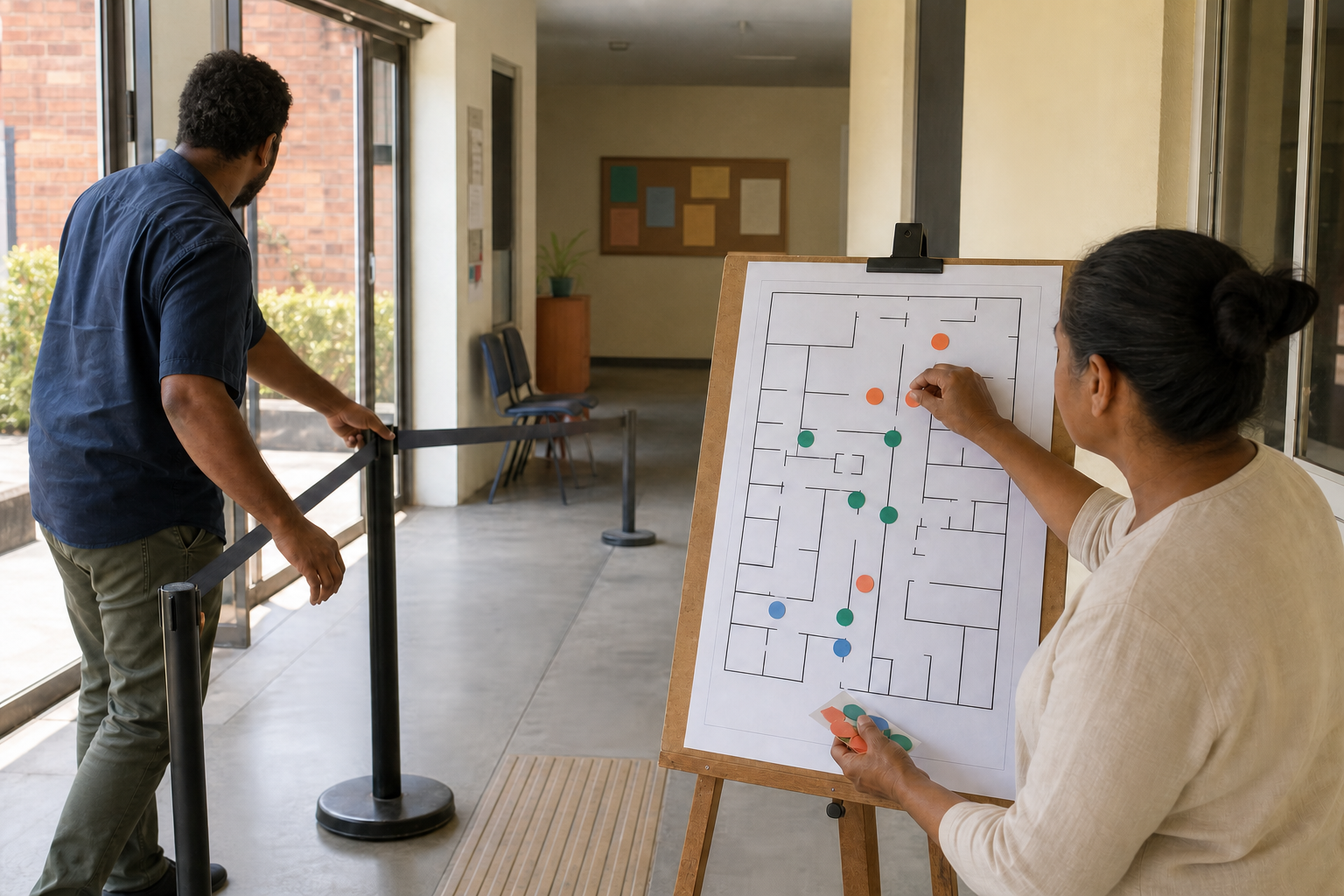
The image shows that distinction in one scene. The person at the barrier makes the physical change; the person at the board preserves the route that was observed. Colored markers can show where visitors hesitated and where the revised turn begins. Without that before-and-after record, the team may remember only that the second arrangement felt smoother.
This also protects the site's method for framing an adaptive public-health challenge before choosing a solution. Moving a barrier is a technical action. Understanding why different visitors read the space differently may remain an adaptive question. A clear record prevents the convenient action from being mistaken for the complete explanation.
Give one change a compact six-field record
The FRAME reporting approach was created to describe modifications consistently. Its authors recommend recording features such as what changed, who participated, when the change occurred and why it was made. The FRAME paper on documenting adaptations is useful here because it keeps the reason for a modification beside the modification itself.
A local team does not need to copy a research instrument into every field note. It can preserve the same discipline with six labelled fields:
- Observed signal
- What happened, where it happened and how often it was seen.
- Current interpretation
- Why the team thinks the signal occurred, including a plausible competing explanation.
- Exact change
- The one feature altered now, such as moving the barrier before changing signs, staffing and timing together.
- Protected core
- The purpose or essential element that must remain intact while the delivery changes.
- Decision owner
- Who approved the adjustment and who needs to know before the next session.
- Review trigger
- The date, observation or threshold that will prompt the team to keep, revise or reverse the change.
In the entrance example, the exact change is the barrier position, not âimprove access.â The protected core is an entrance route that visitors can use with dignity and without unnecessary disclosure. The decision owner might be the on-site lead, while the review trigger could be the first ten arrivals at the next session. These fields make the note usable by someone who was not in the room.
Let the next review test the reason, not just the result
A change can appear successful for the wrong reason. The revised entrance may work because a particularly experienced staff member gives directions, because the next group already knows the building, or because attendance is lower. The review should therefore test the explanation recorded earlier. If the team thinks the barrier position caused missed turns, it should observe the route under comparable conditions before declaring the problem resolved.
The WHO Implementation Research Toolkit connects practical implementation questions with stakeholder involvement, evidence collection and the use of findings. A mid-course record can do the same on a smaller scale: it states the question created by the adjustment, names who will observe it and says how the result will shape the next decision.
Link the review trigger to the site's practice of setting a pause rule before a public-health pilot starts. A pause rule says when continuing unchanged would be irresponsible or uninformative. The mid-course record says what the team did when that signal appeared. Together they preserve the sequence from planned criterion to observed event, authorised change and later review.
The record can be brief, but it should never end with âadjusted as needed.â Name the signal, interpretation, exact change, protected core, decision owner and next trigger. That small discipline helps a team learn across sessions, explain its judgement to partners and reverse a change when the original reason no longer holds.