A planning table can agree on the numbers and still disagree about what they mean. One partner sees a service problem, another sees a transport barrier, and residents describe a trust problem that is not visible in the dashboard. Treating one interpretation as the neutral answer usually hides the adaptive part of the challenge.
The useful response is not to force quick consensus. It is to make each interpretation visible, identify what evidence could change it and choose a small next action that is safe to revisit. If the group has not yet named the decision it needs to make, begin with the site's guide to framing an adaptive public-health challenge. Then use the method below when the evidence is shared but the explanations are not.
Name what is actually disputed
Start by asking each participant to state one observation without explaining it. "The evening clinic filled more slowly than the daytime clinic" is an observation. "People do not value the service" is an interpretation. "We should extend outreach" is a proposed priority. Writing those three kinds of statement in separate columns prevents a proposed action from being mistaken for a fact.
WHO guidance on citizen engagement describes citizens' voices as an important and often underused form of evidence in policy and decision-making. In practice, that means a resident's account should not be placed in a decorative "feedback" box after the data discussion. Record who observed what, when and under which conditions, just as the group records the limits of a survey or administrative dataset.
| What was observed | Possible explanation | What could change our view | Who can verify it |
|---|---|---|---|
| A service was used less often in one location. | Hours, transport, trust or eligibility may matter. | A different pattern by time, route or group. | Residents, front-line staff and the data owner. |
| A referral step was often incomplete. | The hand-off may be unclear or too burdensome. | A joint walk-through of the current process. | People making and receiving the referral. |
The aim is not to produce four perfect columns. It is to show the group where agreement ends. A dispute about a count needs a data check. A dispute about cause needs a learning question. A dispute about which outcome matters is a value and governance question; more data alone will not settle it.
Take the argument to the place it describes
When feasible, move one part of the discussion out of the meeting room. A short field walk, service walk-through or joint observation can reveal details that neither a chart nor a remembered anecdote captures. The purpose is not to collect a statistically complete sample. It is to test whether the group's explanations survive contact with the setting and the people affected.
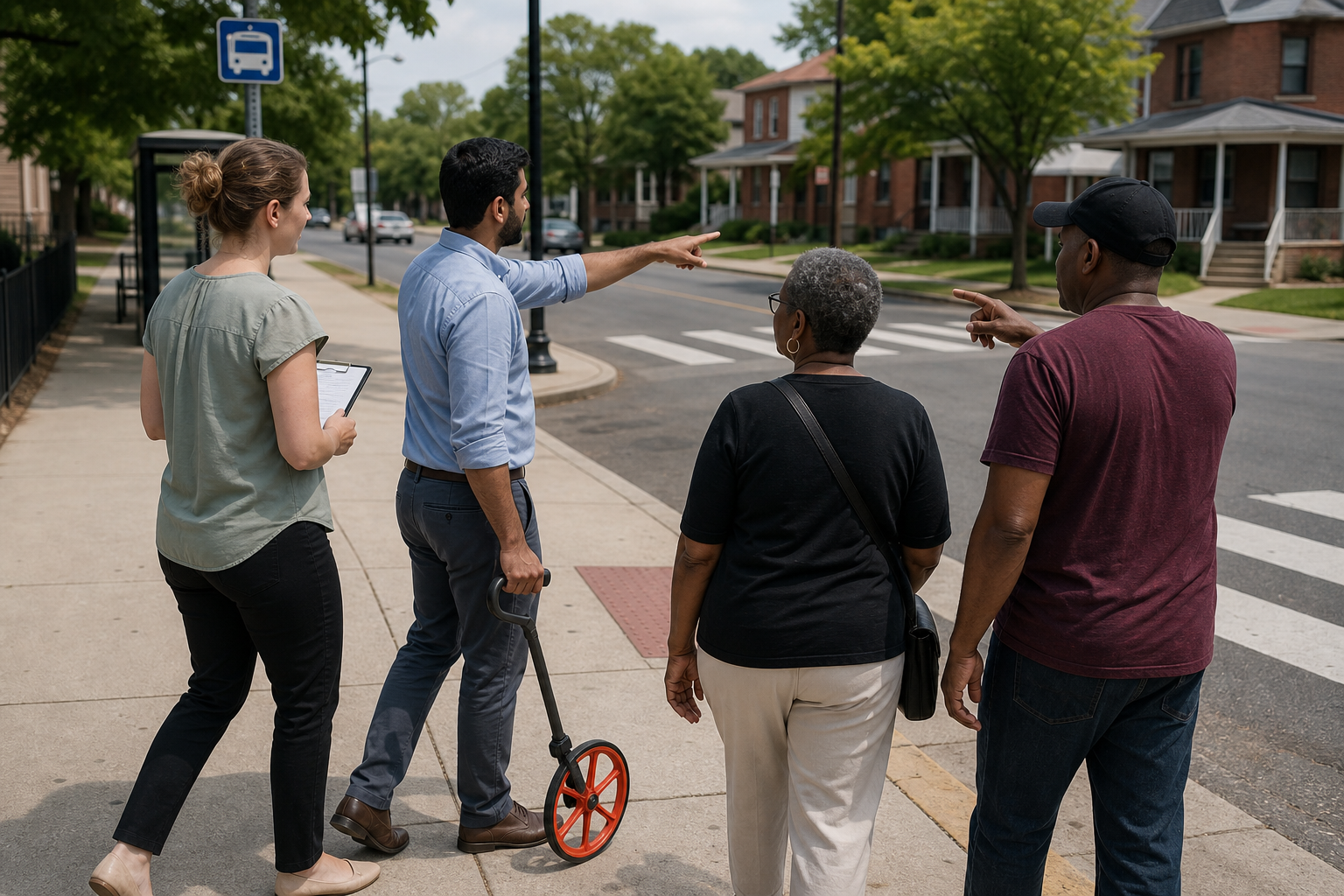
The CDC overview of Health Impact Assessment notes that affected populations should be engaged during scoping and assessment, and that both qualitative and quantitative evidence may inform recommendations. Before the walk-through, agree on the decision boundary, the locations or process steps to observe and the questions participants may ask. Do not collect personal health details or promise a change that the team has no authority to make.
During the observation, keep the two roles distinct. One person records visible conditions and process steps; another records questions raised by residents and staff. At the end, ask which explanation gained support, which weakened and which new explanation appeared. That debrief turns a visit into evidence rather than a photo opportunity.
Write competing explanations as testable expectations
A planning group does not need to vote on the most persuasive story. Write two or three live explanations and state what each would lead the team to expect. If limited hours are the main barrier, use should change when hours change. If trust is the main barrier, an extra time slot may have little effect unless the messenger or setting changes. If a referral hand-off is the problem, the break should appear at a specific step rather than across the whole service.
This is where the site's five-step planning process becomes useful: the evidence question should guide what information is collected and which feasible option is considered. A federal Learning Agenda comparison similarly separates priority questions from the evidence activities used to answer them and says those activities should align with the question being asked. Keep the next evidence task proportionate. A two-week process count, three structured walk-throughs or a review of one referral route may be enough to decide what to test next.
Record in advance what result would strengthen each explanation, what result would weaken it and what would remain ambiguous. Without that agreement, teams can reinterpret every new result as support for the view they already held.
Decide what can move now and what must stay open
Not every disagreement has to be resolved before action. The group may be able to correct a known technical fault while keeping an adaptive question open. It can clarify a referral form today and still test whether people trust the referral source. The site's explanation of technical and adaptive challenges helps prevent a straightforward repair from being delayed, while also preventing that repair from being presented as the whole solution.
Close the session with a short decision record in plain language:
We agree that [observation]. We are still testing [competing explanations]. By [date], [named owner] will gather [specific evidence] with [affected people or partners]. The group will reconsider the decision if [observable signal] appears.
That record leaves uncertainty visible without allowing it to stop all progress. It also makes the next review more honest: participants can compare what they expected with what actually happened instead of reopening the argument from memory.
A useful planning record does not erase disagreement
The strongest outcome is not a room that sounds unanimous. It is a record that distinguishes observation, interpretation and priority; includes people who hold missing knowledge; identifies what could change the team's view; and gives one person responsibility for the next bounded evidence task. When those elements are visible, disagreement becomes part of the learning process rather than a reason to choose the most familiar solution.