A small public-health pilot should make uncertainty easier to manage, not merely produce an activity report. Before the first participant arrives, the team needs to agree which visible signal would justify continuing, changing the setup or pausing it. Otherwise the calendar, the loudest opinion or the money already spent can decide what happens next.
The updated MRC framework for complex interventions says feasibility work should use predefined progression criteria and resolve the uncertainties that matter before a later phase. That principle can be translated into a plain planning habit: write the pause rule while the team is still calm, before an awkward result needs to be explained.
A pause rule protects the learning question
Imagine a community team testing a new entrance arrangement for a short public-health session. The practical aim is simple: people should find the route, move through it comfortably and reach the right person without an unnecessary detour. The learning question is narrower than “Did the event work?” It asks whether this particular arrangement makes the entry clearer for the people who will actually use it.
The team writes its pause rule before opening the doors. It will stop the flow briefly if people repeatedly turn back, if the barrier creates a tight corner, or if staff must give the same correction several times. None of those signals proves that the whole service is wrong. Each one says that continuing unchanged would teach less than a quick adjustment and another observation.
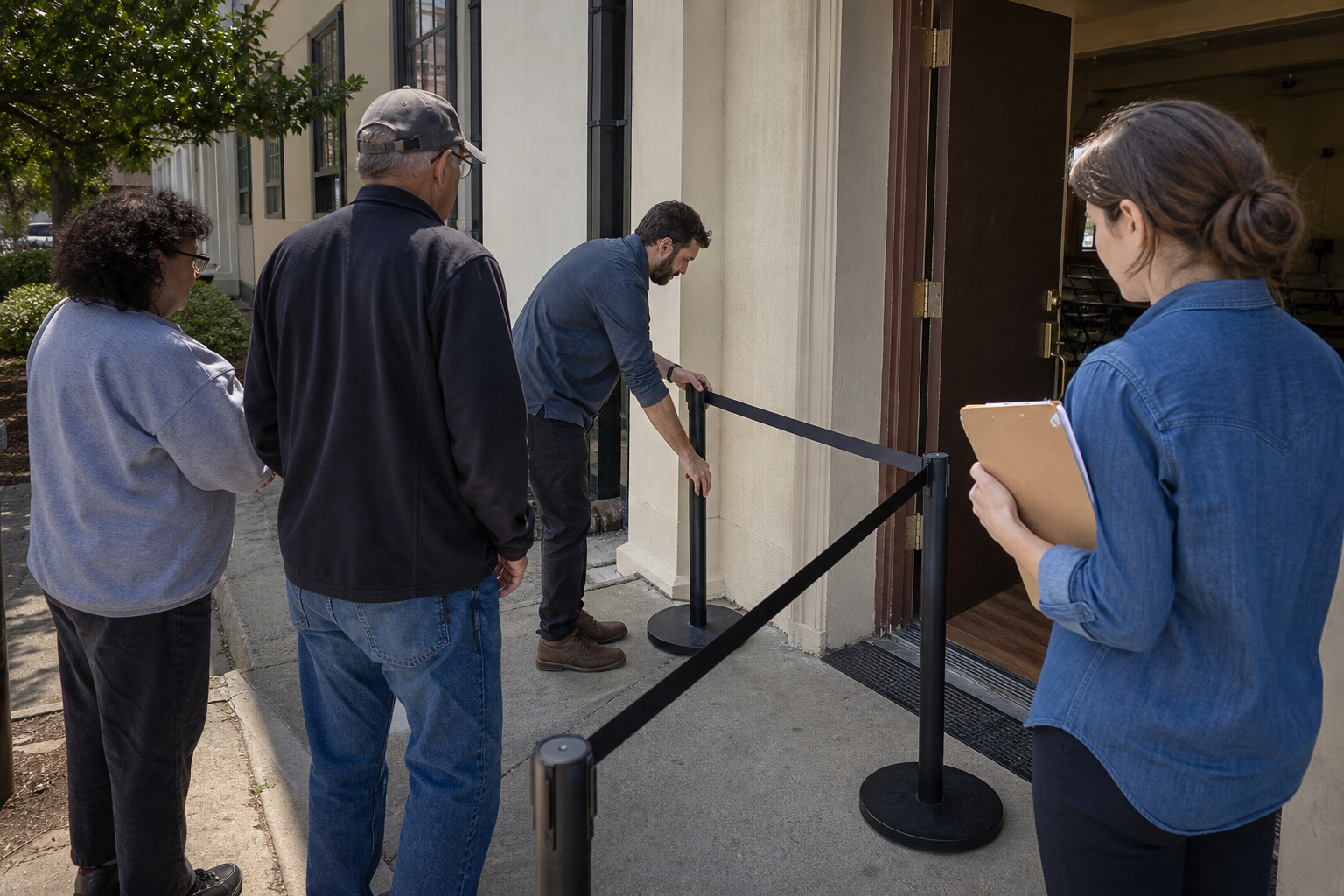
This is where the site's distinction between technical and adaptive parts of a challenge matters. Moving one barrier is a technical correction. Understanding why some participants hesitate, whom they trust for directions or whether the setting feels welcoming may remain adaptive questions. The pause prevents the easy correction from being confused with the complete answer.
Choose signals that can change the next move
A useful signal is close enough to the pilot for the team to observe and specific enough to change a decision. It might be the same missed turn occurring several times, a hand-off that repeatedly needs a second explanation, a route that one group cannot use comfortably or a task that takes far longer than the trial allowed. A broad outcome such as “community confidence” may matter greatly, but it is rarely a sensible minute-by-minute pause signal.
Do not pretend that every signal has a universal threshold. Three confused arrivals may be important in a trial with ten participants and uninformative at a large event. The team should name the size and duration of the test, who will watch, what will be recorded without collecting unnecessary personal information and who has the authority to pause. That makes the criterion usable rather than decorative.
WHO guidance on planning pilot projects with later use in mind treats pilot design as more than a one-off demonstration. The practical lesson is to connect each observation to a future choice. If a signal would not change the layout, the support, the question or the decision to continue, the team should ask why it is collecting it.
The same afternoon can have three honest endings
A pilot can continue when the intended route works under the conditions tested and no agreed pause signal appears. “Continue” does not mean “proven everywhere.” The note should say where, when and with whom the arrangement was observed, plus the uncertainty that remains outside that boundary.
It can adapt when the signal points to a reversible feature. In the entrance example, the team moves the barrier, changes where a staff member stands and watches the next arrivals. The important record is the difference between the first and second arrangement. If several changes happen at once, the team may create a smoother event but lose the ability to learn which change mattered.
It can pause when the signal concerns safety, access, privacy, the purpose of the trial or a problem the team cannot responsibly correct on site. A pause is not a failed pilot. It is a decision not to keep exposing people to a known problem while the group gathers the authority, knowledge or resources needed for a better test.
The World Health Organization's recent guidance on scaling innovations in public-health systems places exploring, adapting and learning at the centre of moving beyond promising pilots. Those verbs are useful at a small scale too. The team observes what happened, adapts only what the evidence supports and keeps the remaining uncertainty visible.
Carry the unresolved question into the next round
The closing note can be short. State the arrangement tested, the people and setting included, the pause signal observed or absent, the change made, the result after that change and the question that is still open. Name who will decide whether the next round repeats, expands or stops. A dated record is more useful than a polished summary that hides the sequence.
If partners interpret the signal differently, do not erase that difference. Use the site's method for recording competing readings of the evidence, then agree what observation could change each view. The next pilot should answer that narrower question instead of replaying the same argument with a larger audience.
A pause rule is therefore not an emergency brake added after trouble begins. It is part of the design. It protects participants from avoidable repetition, protects the learning question from sunk-cost thinking and gives the team three legitimate outcomes: continue within the tested boundary, adapt one feature and observe again, or stop until a material uncertainty can be resolved.