A public-health planning meeting can move quickly from a difficult question to a familiar programme, policy or communications tactic. That feels productive, but it can hide the real work. When the challenge crosses organisations, depends on trust or behaviour, or affects groups differently, the team may need to learn its way forward before it can choose a durable solution.
Use this guided practice to turn a broad concern into a decision-ready question. The aim is not to solve the whole challenge in one meeting. It is to agree what is known, what still has to be learned, who must be involved and what small action will produce useful evidence next.
STEP 1: Start with the decision, not the broad problem
Write the decision that someone will need to make in the next 30 to 90 days. “Improve access” is a goal, not a decision. “Which two access barriers should our partnership test first in the north district?” is closer to something a team can act on.
- Who will use the answer?
- What decision will the answer change?
- By when is the answer useful?
- What happens if no decision is made?
This keeps the session connected to action. It also stops the loudest or most familiar issue from automatically becoming the planning question.
STEP 2: Separate technical work from adaptive work
Some parts of the challenge may have a known method. A dataset can be cleaned, a contract can be reviewed, or an appointment process can be mapped. Those are technical tasks even when they take expertise and time.
The CDC Program Evaluation Framework, 2024 begins with assessing context and treats collaborative engagement, equity and learning from insights as actions that run through the whole process. Use that as an early framing test: whose context is missing, whose experience could alter the team's explanation, and when will the team revisit its assumptions?
Adaptive work is different. The answer depends on people changing priorities, relationships, assumptions or routines. If residents do not trust the service, if partner organisations define success differently, or if a proposed improvement shifts burden onto another group, a technical fix alone will not settle the issue. Review the tool's existing Technical v. Adaptive Challenges page before labelling the whole problem as one or the other.
Divide a sheet into two columns. Put work with a reliable method on one side. Put questions that require learning with affected people and partners on the other. Most important public-health challenges contain both.
STEP 3: Collect evidence that can change the question
Do not gather data simply to confirm the first explanation. Ask what evidence would make the team rewrite the question. That might be a different pattern by neighbourhood, a service user's account that contradicts the process map, a partner's capacity limit, or evidence that the assumed barrier is not the one people experience.
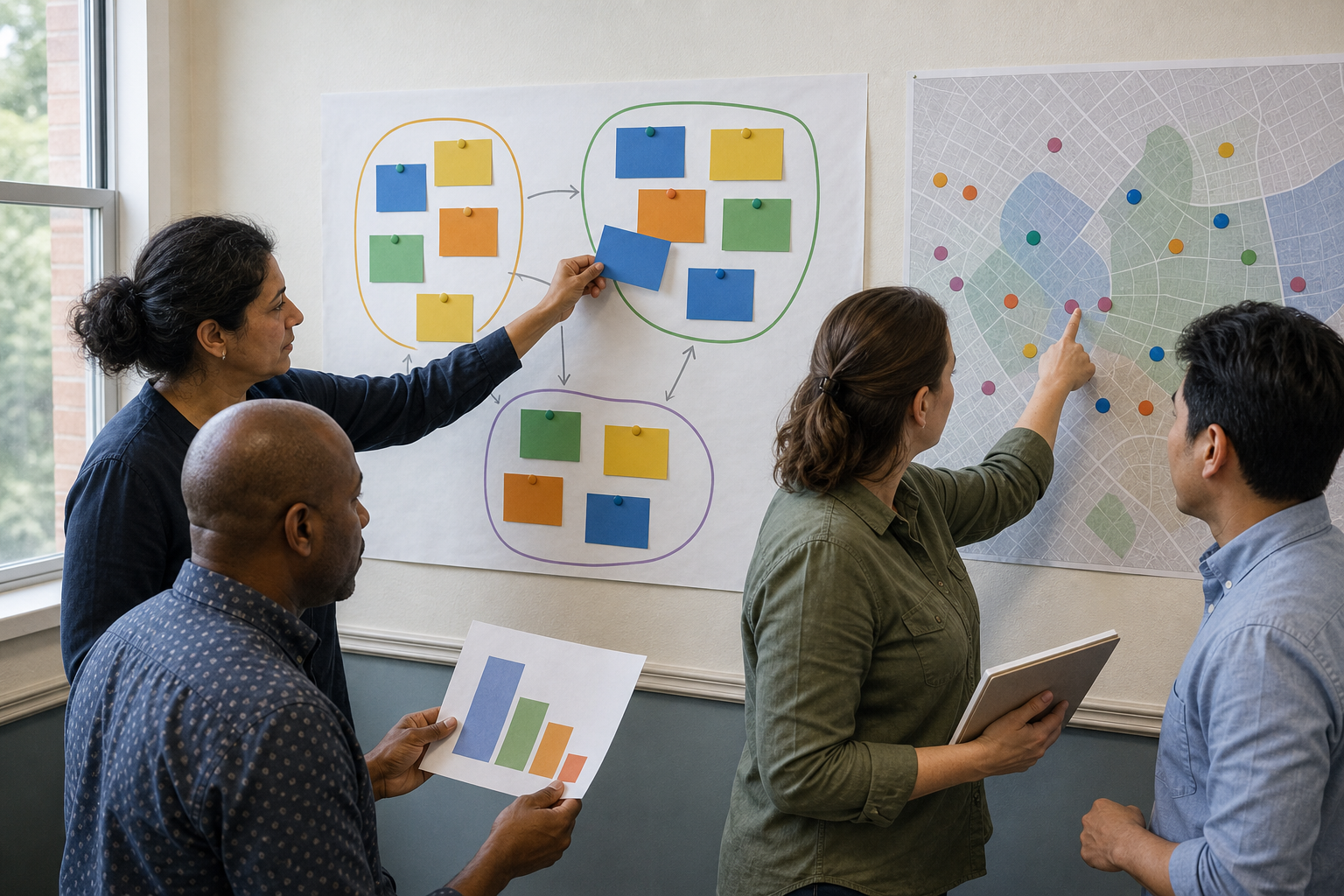
Choose a small mixed evidence set rather than an impressive but disconnected data pack:
- one measure of the outcome or service pattern;
- one view of how the current process actually works;
- direct experience from people affected by the decision;
- a partner view of resources, constraints and unintended effects.
Record the source, date and limitation beside each item. If the group cannot say what a piece of evidence might change, it probably does not belong in the first round.
STEP 4: Put the people who hold the missing knowledge into the question
Do not write “How can the health department increase uptake?” if success depends on clinics, schools, community organisations and residents. Write the question so that shared work is visible: “What would our local partnership need to change so that families can reach and trust the service?”
NACCHO's guidance on community health assessment and improvement planning describes cross-sector relationship building, broad community engagement, assessment of needs and strengths, and collaborative action as parts of a successful improvement process. Translate that into a meeting rule: include people with lived and operational knowledge early enough to change the framing, not only to react to a finished plan.
- Does the draft question name the population or place affected?
- Does it allow more than one explanation to remain possible?
- Can the people named in it influence the next action?
STEP 5: Turn one assumption into a small learning test
Select the assumption that is both uncertain and important. Then choose a reversible action that can test it without pretending to be the final programme. A two-week walk-through with service users, a trial hand-off between two partners, or a small change to one appointment route may reveal more than another month of general discussion.
We believe [assumption]. We will try [small action] with [people/place] by [date]. We will reconsider the question if we observe [specific signal].
Agree in advance what result would support the assumption, what would weaken it and what would be ambiguous. A learning test is useful even when it disproves the team's starting view.
STEP 6: Name ownership and the next review
A planning question is not ready if everyone supports it but nobody owns the next move. Name one person responsible for organising the test, one person accountable for the decision, the partners who must be consulted and the people who need the result. Keep the arrangement proportionate to the work.
ASTHO's resource on clear roles and responsibilities for public-health plans recommends making ownership, decision authority and accountability explicit, then using short-cycle check-ins to adjust when roles or context change. Set the first review date before the meeting ends.
Use the site's five-step planning process to carry the reframed question into fuller planning. The immediate output should be simple: one decision-ready question, a short evidence map, one learning test, named ownership and a date to look again. That is enough to replace premature certainty with structured progress.